
🧠 ORGANISATIONAL HEALTH
Treating organisational health as a kinetic chain
Why the fastest route to organisational progress begins at the point of greatest strain.
🔍 Why it matters
Most organisations talk about “health” as if it were a static condition: a dashboard, a score, a set of hygiene factors. But organisational health, as it’s commonly used, still treats companies as mechanistic systems—machines to be tuned, capabilities to be optimised, departments to be re‑aligned.
HITMXE® works from a different vantage point: a business behaves far more like a human body than a machine. Equating complex systems to human systems makes them easier to relate to, and this is why we can work with individual founders as readily as Owners or Corporates.
Human systems adapt, compensate, over‑rely on strong muscles, and hide weaknesses until the strain becomes impossible to ignore. Organisations do exactly the same. They build awkward workarounds, ignore warning signs and normalise the pain until something snaps - often saying that they "didn't see it coming", because whilst there’s awareness of the pain, no one could quite name it.
“Every organisation has a kinetic chain and that chain has weak links.”
🔮 What we explore
In the human body, a kinetic chain is the interconnected sequence of muscles and joints that allow movement. When one part is overloaded or under‑supported, the entire chain compensates—often in ways that create more pain elsewhere.
Organisations behave identically. A single overloaded function, unclear boundary, or incoherent decision path can quietly distort the whole system. Before you can talk about vision, innovation, or transformation, you must diagnose where the strain is already accumulating.
1. Naming the Pain — and Why Language Reveals the Truth
Everyday language reveals where the organisation is compensating — bottlenecks, firefighting, reactivity, overload.
These are presenting symptoms, not causes. The real strain sits deeper in the system.
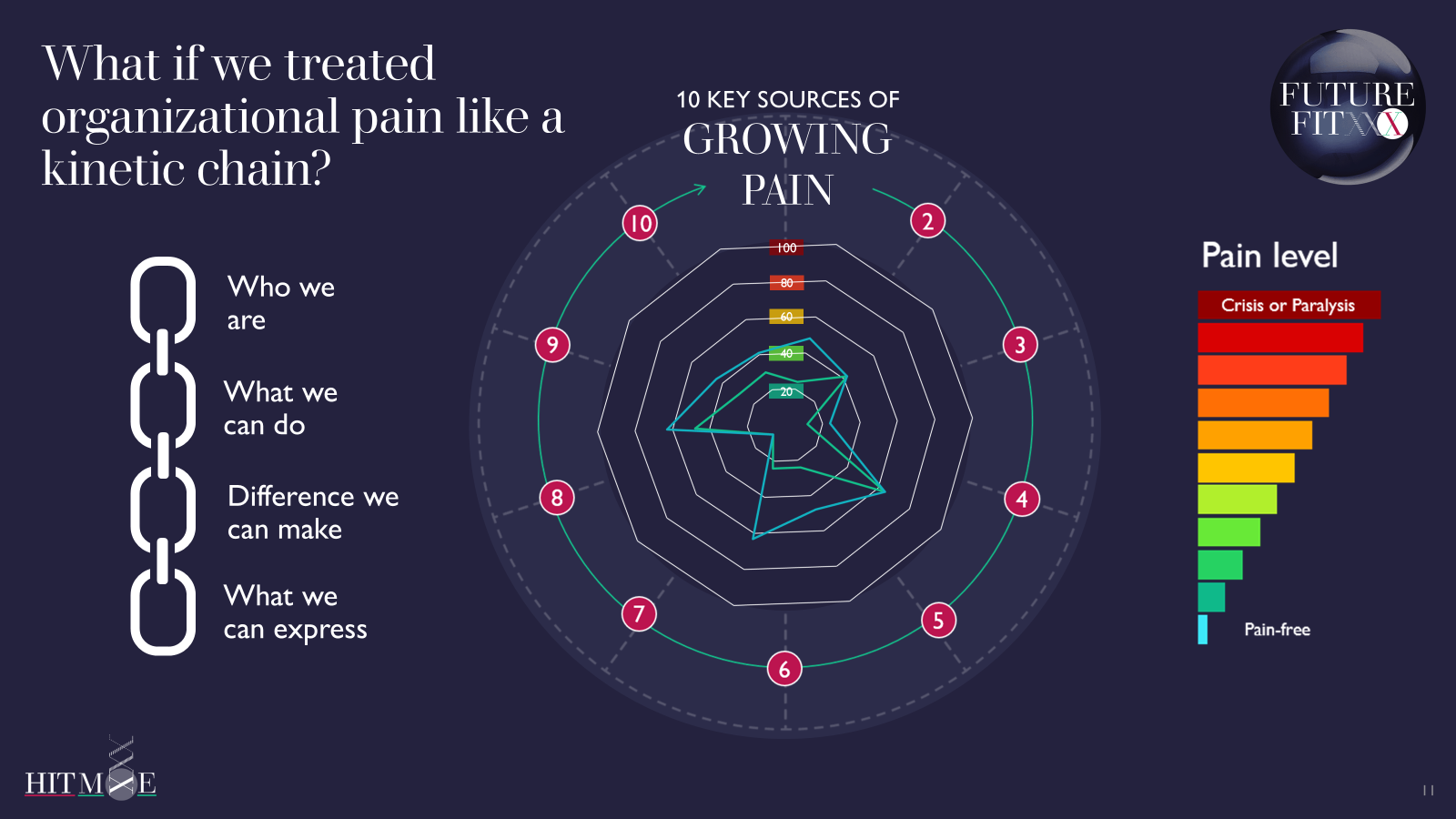
Ten recurring sources of growing pain distort the kinetic chain across organisations of every size.
Until these are diagnosed, assessed for severity and addressed, strategy and innovation rest on a compromised foundation.
2. Releasing operational capacity — not just solving pain, but increasing tolerance for strain
Once the true sources of strain are identified, targeted relief restores the organisation’s ability to absorb pressure.
This is not symptom‑soothing — it’s strengthening the system’s tolerance for load.
Reinforcing the kinetic chain frees teams from compensation patterns and recovers trapped capacity.
The result is faster recovery from setbacks and a more resilient operating rhythm.
3. Releasing creativity — when pain lifts, anticipation returns to fill that space
Creativity is the clearest sign of pain relief — unrestricted movement, clear thinking, and genuine problem‑solving.
When organisations are firefighting, imagination collapses into survival mode.
When strain is reduced, creativity becomes kinetic again — grounded, divergent, and operationally relevant.
This is where teams begin to design new practices and generate ideas rooted in reality, not theatre.
👥 Who is this for?
1️⃣ Executives who inherit complexity and seek clarity of action
2️⃣ Leaders who feel the acceleration but can’t yet absorb it
3️⃣ Founders who feel the system tightening around them as bottlenecks emerge early
4️⃣ Operators who know something is breaking but can’t name pain clearly or qualify its severity
5️⃣ Project Teams exhausted by “alignment workshops” that workround the real issue
🛠️
Engagement format examples
-
“Reveal & Release”
We can’t always start with a visionary strategy, without first treating the presenting problem. Our analysis revealed ten key sources of pain. We address them quickly and systematically through a proprietary kinetic diagnostic. This shapes any HITMXE® assignment.
-
“Naming the Pain”
A facilitated session that surfaces presenting symptoms, reveals hidden strain, and gives teams the language to describe what’s actually breaking
-
“Pain as a Map”
A provocative talk on why the fastest route to progress begins at the point of greatest strain — and how leaders can use pain as data.
💭 Final thought
Acceleration is not slowing down. Complexity is not easing. And organisations cannot keep absorbing pressure through heroic effort or cultural optimism. The most sustainable path forward is a kinetic one: diagnose the pain, relieve the strain, and strengthen the chain, so humans can operate more effectively under load. We promise to meet anyone feeling the pain in the “hit me” moment of truth. A statement of intent and a shared openness to take risks, invest enthusiasm, speak candidly and face consequences.