
Measuring future-fitness
👁️🗨️ BUSINESS INTELLIGENCE
A living dashboard for outcomes. Not siloes.
Most organisations aren't short of measures. They're drowning in them.
Revenue. Engagement. Utilisation. Efficiency. Experience. Innovation. Performance.
The problem is that these measures tend to live where the organisation lives: inside functions, systems and reporting structures.
But organisations don't succeed or fail function by function.
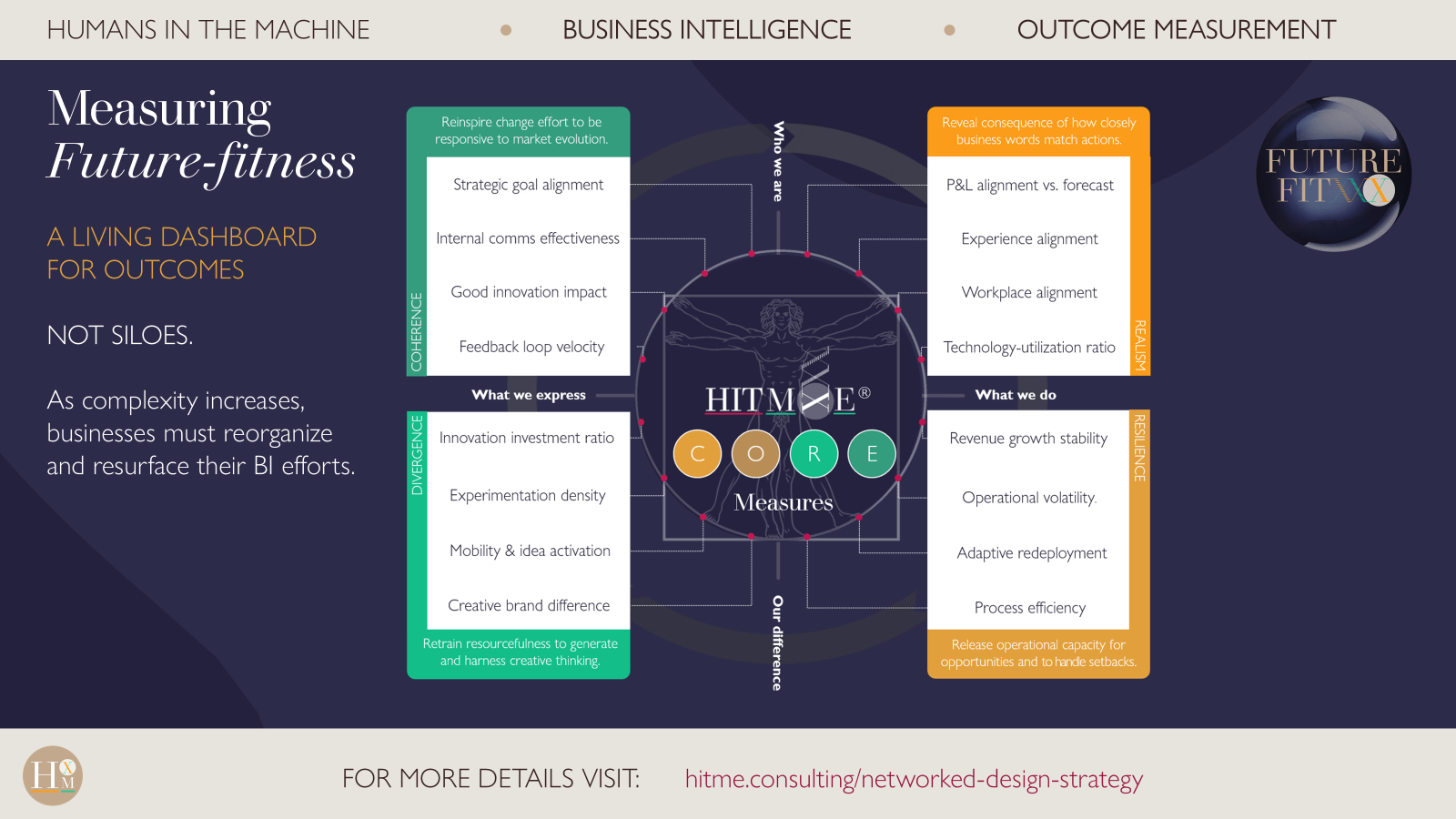
HITMxE Measurement looks across those boundaries to understand whether what an organisation says, does and invests in is actually creating the coherence, differentiation, realism and resilience it needs for what comes next.
🔍 Why it matters
What gets measured doesn't necessarily tell you what matters.
Traditional business intelligence is good at telling organisations what happened within a defined area of the business.
It is less good at revealing the relationships between those areas.
A business can hit individual targets while becoming less coherent overall. Innovation activity can increase without creating meaningful differentiation. Technology investment can grow without increasing organisational capacity. Strong operational performance today can disguise declining adaptability tomorrow.
As complexity increases, measurement needs to evolve with it.
HITMXE Measurement reorganises and resurfaces business intelligence around outcomes across the organisation, rather than treating individual functions as isolated indicators of health.
The question changes from “are our individual metrics improving?” to “is the organisation becoming more future-fit?”
👥 Who is this for?
HITMXE Measurement is for organisations that already have data but aren't convinced they have insight.
Particularly when:
dashboards are multiplying but decisions aren't improving;
different functions can each demonstrate success while overall performance feels less convincing;
transformation activity is difficult to connect to meaningful organisational outcomes;
investment in people, technology or innovation isn't producing the expected movement;
leadership needs to understand capacity for change, rather than simply monitor today's performance;
existing KPIs describe the parts of the organisation better than the organisation as a whole.
It is particularly relevant where complexity and interdependency have outgrown conventional siloed reporting.
🔮 What we explore
The model looks at the organisation through four interconnected dimensions:
Coherence
How well what the organisation expresses aligns with what the organisation is actually trying to achieve.
Divergence
Whether the organisation retains sufficient difference, experimentation and resourcefulness to create new possibilities rather than simply optimise existing ones.
Realism
How closely business assumptions, commitments and intentions correspond with what is actually happening.
Resilience
Whether the organisation has sufficient capacity and adaptability to absorb setbacks while continuing to move.
Together, these provide a different way of interpreting existing business intelligence.
Rather than producing another collection of functional KPIs, the model looks for the relationships, tensions and consequences between them.
The detailed diagnostic and measurement logic remain proprietary to HITMXE.
🛠️
Engagement format examples
-
What Are We Really Measuring?
A working session that challenges siloed KPIs and reframes existing measures around organisational outcomes and future-fitness.
-
Building a Future-Fit Measurement System
Reorganise and resurface existing business intelligence through Coherence, Divergence, Realism and Resilience, creating a living view of organisational future-fitness.
-
You Can Measure Everything and Still Miss What’s Happening
A provocative look at why more data doesn't necessarily mean better organisational intelligence, and what leaders need to see beyond conventional dashboards.
💭 Final thought
You can measure everything and still miss what's happening. The more complex an organisation becomes, the less useful it is to understand each part only on its own terms. Future-fitness emerges from relationships: between intention and action, investment and outcome, difference and conformity, efficiency and adaptability. Those relationships are often hiding in information the organisation already collects. The challenge isn't always finding more data. It's learning to see what the data means together.