
Why we don’t need “abundance” nearly as much as we need agency
“Abundance” is the wrong term for the right instinct. It tries to gesture at a humane future for all, but collapses into the elitist, neoliberal slogan trap - a binary reaction to scarcity that refuses to name the actual human condition it claims to address. We examine the data and make the case for “agency” as a new lens for a stalled century.
◴ Reading time: 10 minutes
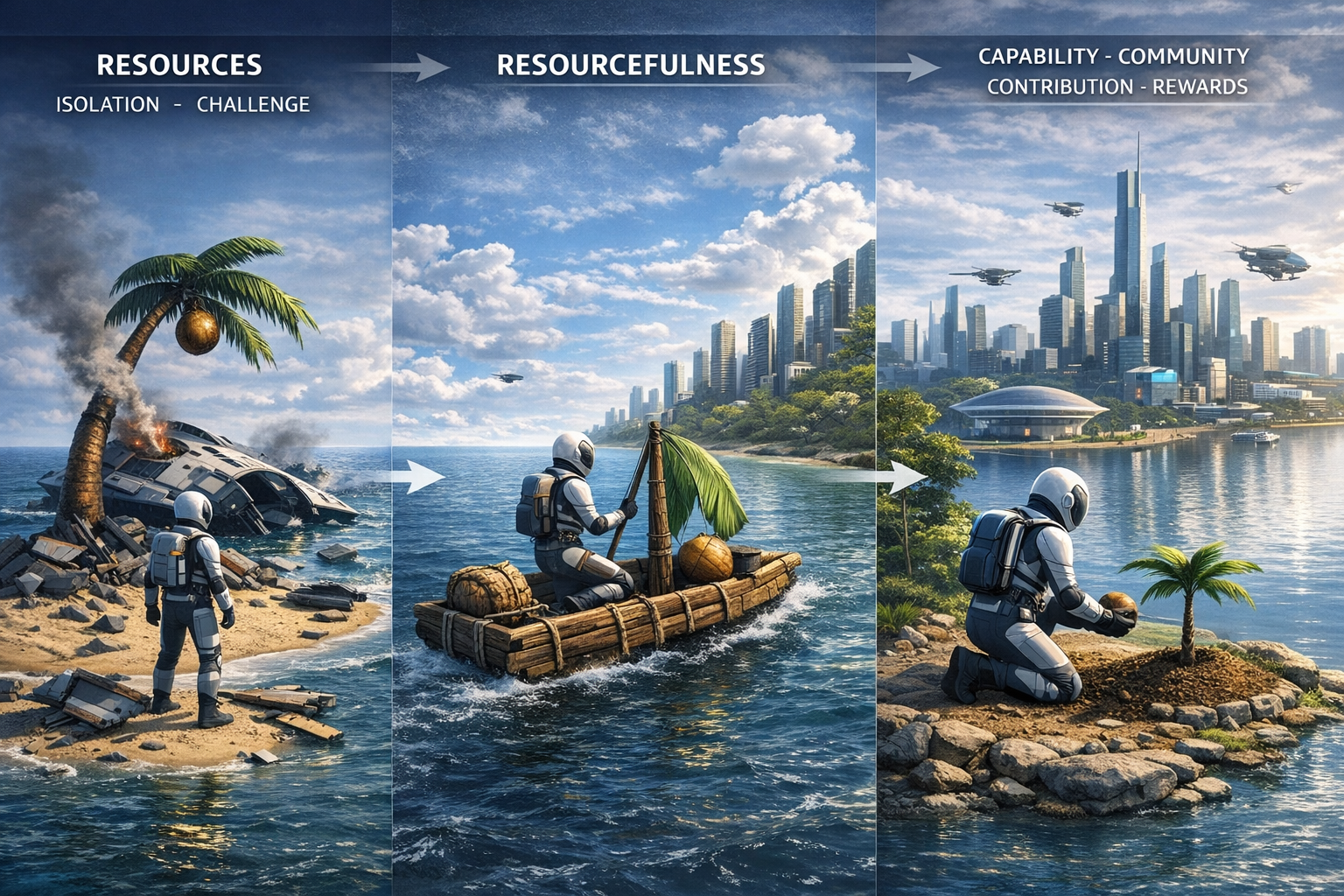
For most of the last century, our economies have been arranged around a simple idea: human progress is harnessed by competition, efficiency, and productivity. When the world was simpler, this framing worked well enough. It gave us a language for growth, a set of levers for policy, and a story about how societies improve.
The 21st century has exposed the limits of that worldview. The data is unambiguous: human development has stalled, productivity is slowing, and innovation is becoming harder. The metaphors we inherited — scarcity, abundance, efficiency — no longer describe the world we inhabit, reducing the human condition to a set of economic inputs and outputs, and leaving people unable to name what is actually missing.
Not autonomy. Not self‑optimisation.
What’s missing is agency.
The human ability to act with consequence, with others, in a world that is increasingly interdependent.
Agency is not a politicians slogan. It’s not intellectually distancing. Agency is freedom applied to problems. It should be considered as both a human right and a developmental arc — capacity, mutuality, orientation, and decency — and it is the one thing our current economic model does not measure, cultivate, or reward. Yet it is the only thing that can carry us into a century defined by complexity, fragility, and accelerating technological power.
The data shows the old story is fast running out of road
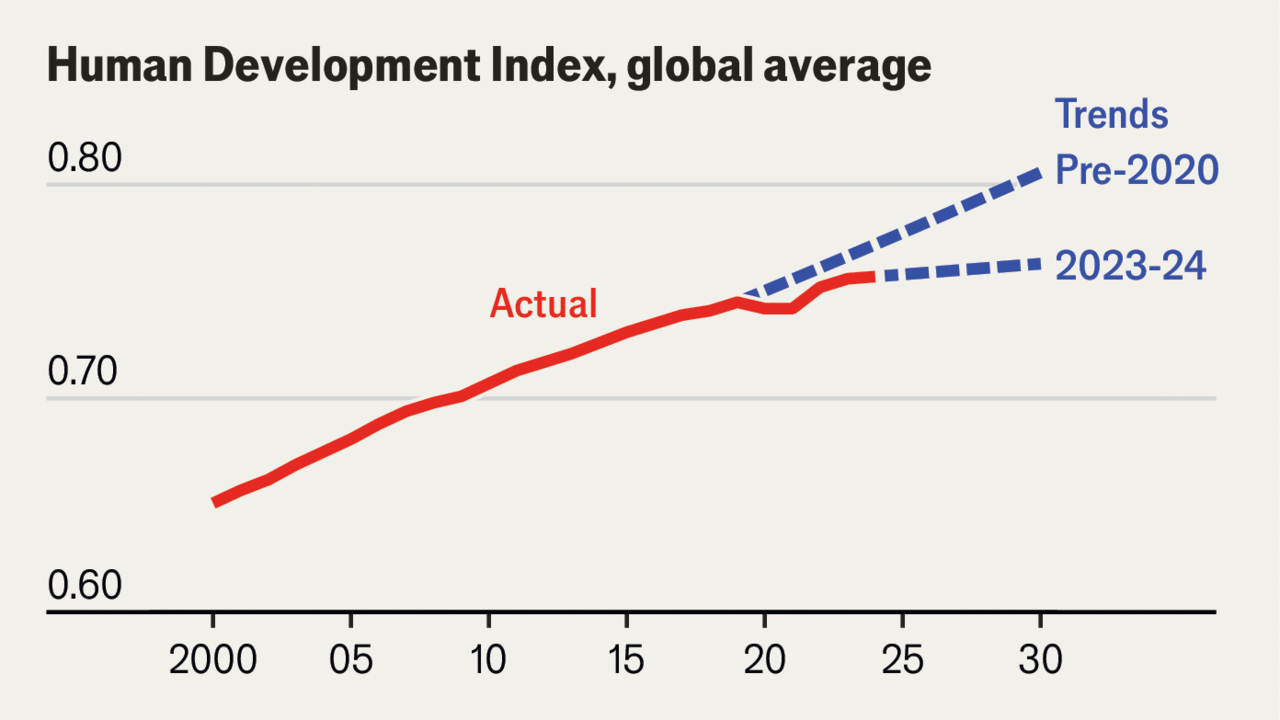
Which countries have the best, and worst, living standards? The Economist, May 2025.
The Human Development Index — the world’s broadest measure of wellbeing — has effectively flatlined. UN data shows that HDI growth across very high‑HDI countries has slowed to 0.1–0.3% annually over the past decade. We are adding more technology, more compute, more connectivity, yet the lived experience of development is stagnating for most people around the world.
Productivity tells the same story. The OECD reports a widespread slowdown in productivity growth across advanced economies, with multifactor productivity (MFP) growth remaining weak through 2023–2024. The World Bank describes the past decade as “the broadest and most persistent slowdown in productivity growth in decades.” The IMF places global GDP growth at 3.1%, with advanced economies at 1.6%, reflecting structural stagnation rather than cyclical fluctuation.
Innovation, too, is cooling. Complexification makes innovation harder. The Global Innovation Index 2025 notes that R&D growth has slowed, venture capital activity has moderated, and patenting gains remain modest. A majority of global R&D is now oriented toward improving Total Factor Productivity (TFP) — yet TFP itself is slowing. IMF and ECB research both point to declining R&D efficiency and reduced technology diffusion, especially since the Great Recession.
If productivity is the goal, then efficiency is the engine and innovation is the turbocharger. In which case, the engine is misfiring and damaging itself.
What if productivity became one of the desired outcomes? What if we accepted that the singular pursuit of efficiency is no longer the best way to achieve growth? After all, growth should be a combination of progress and productivity.
Efficiency is a false metric in a complexifying world
Efficiency works in closed systems. It works when the environment is stable, when inputs and outputs are predictable, when the cost of failure is low. But the world we inhabit is none of those things. Efficiency strips out redundancy, buffers, slack, and care — the very things that make systems resilient.
Excel accounts for efficiency because Excel has no concept of:
✗ Ecological limits
✗ Emotional cost
✗ Social cohesion
✗ Institutional fragility
✗ Long‑term consequence.
The real world does. We see the waste everywhere, making the productivity narrative feel at best uncanny, at worst illusory.
The global productivity slowdown is not a failure of effort or participation. It is a failure of imagination. We keep optimising for the wrong thing - shouldn’t the last twenty years be telling us that? We built systems that reward throughput rather than capability, extraction rather than contribution, competition rather than cooperation.
Cooperation is not a soft ideal — it is the most innate human baseline
The idea that humans are primarily competitive is a 20th‑century economic myth. Evolutionary research tells a different story. Studies published by the Royal Society show that cooperation and cognition co‑evolved, enabling humans to coordinate in large groups of unrelated individuals. The Max Planck Institute finds that humans cooperate at levels unmatched by other species, including with non‑kin, across cultures and contexts.
Competition is real, but it is secondary and in this context, too transactional. Cooperation is the starting point. It is how infants survive, how communities endure, how knowledge accumulates, how culture transmits, how societies build. We examined this further in our paper The Power of Sameness.
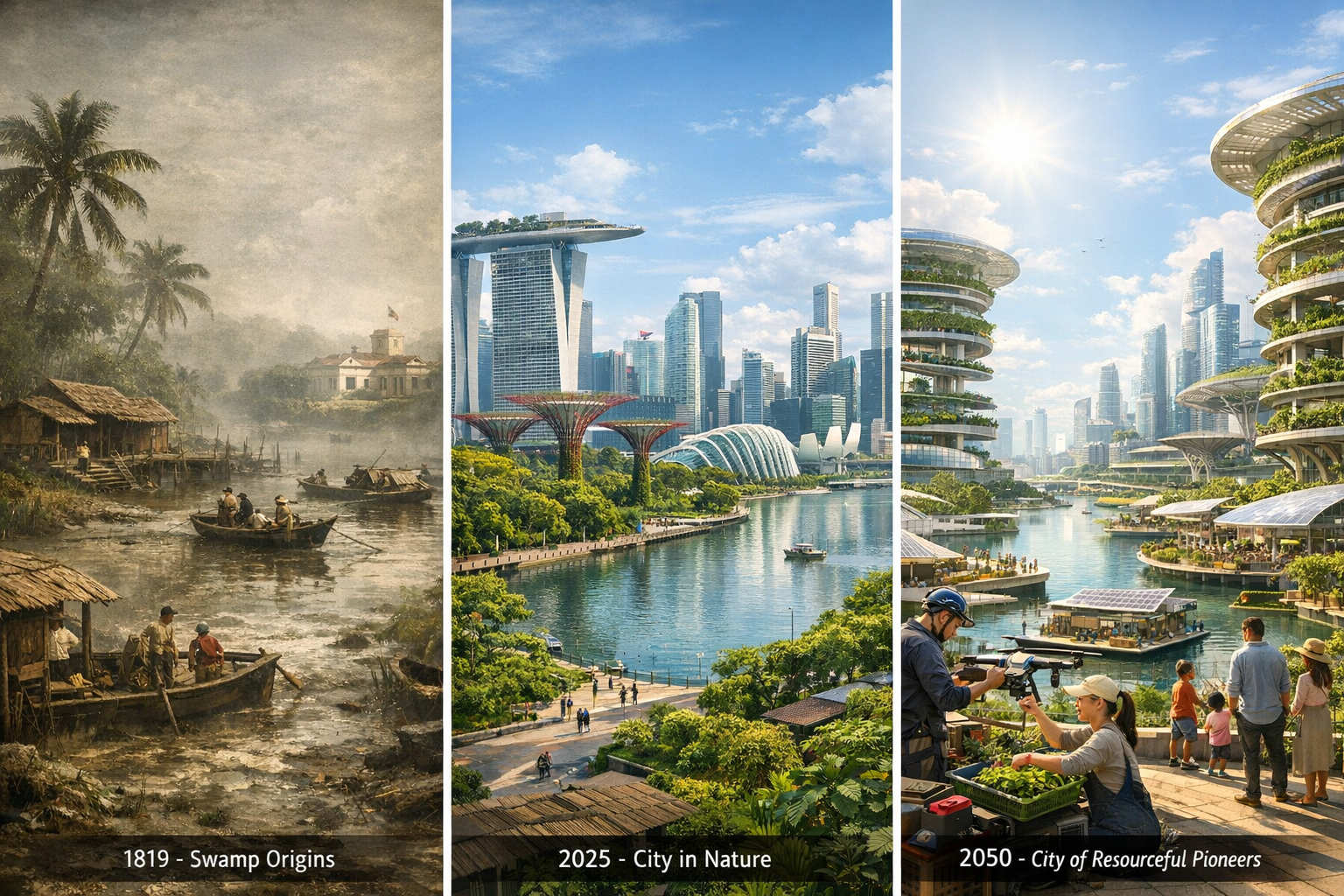
From a vestigial swamp to a global city in nature: Singapore’s early nation‑building years are a modern example of this principle in action. The pioneers were not optimising for efficiency. They were building capability together under constraint — disciplined, adaptive, communal, long‑term oriented. They were not “productive” in the managerial sense. They were resourceful and capable in the civilisational sense.
Agency as the alternative to both scarcity and abundance
Scarcity and abundance are both material metaphors. They tell us nothing about how humans actually navigate the world. They reduce life to quantities — too little, or too much — and assume that wellbeing is a function of supply. The human condition is not a supply‑chain problem.
A society rich in agency feels wealthy even without excess. A society poor in agency feels hollow even with an abundance of things.
Agency is the alternative. Agency expands capacity. Agency grows capability. Agency produces a felt sense of wealth — not through accumulation, but through competence, mutuality, and consequence. This is the pivot the 21st century demands.
The case for resourcefulness
We examined how resourcefulness sits at the intersection of agency, capacity, and capability - that it could represent a true revolution for our times in our essay The Resourceful Revolution. It is the lived expression of agency, meaning the way our agency becomes visible in the world. And agency can in turn restore cultural progress.
Resourcefulness is not cleverness. It is not hustle. It is not improvisation for its own sake. It is the ability to navigate complexity with ingenuity, competence and decency, to adapt without losing orientation, to act with others in ways that increase collective capability. It is these qualities that make agency real.
Resourcefulness has a problem though. How can it be quantified? It is not Excel-friendly like efficiency is. It cannot be reduced to a KPI without killing the very thing that makes it valuable. It is contextual, relational, developmental. It is easier to recognise than to measure. But this shouldn’t be considered as a flaw in the argument. It is a feature.
The things that matter most in a civilisation — trust, maturity, judgement, mutuality, consequence — are not measurable in the way productivity is measurable. They are legible through behaviour, through stories, through witnessed action.
Making resourcefulness tangible without making it rigid means treating it as a pattern, not a score with a trajectory, not a target. It is instilled as a civic expectation, not a bureaucratic metric and a developmental path from youth through adulthood, rather than a performance indicator.
Resourcefulness becomes real when it is cultivated, modelled, rewarded, and socially recognised. It can be recognised through a combination of cooperation, collaboration and competition — not when it is standardised, collapsed and brutalised into one metric.
Capability‑oriented societies
If cooperation is the baseline and agency is the centre, then the economic model must shift accordingly.
What we describe as a capability‑first civilisation means one where:
humans can act with consequence
systems amplify agency rather than erode it
emotional maturity keeps pace with technological power
redundancy is strength, not waste
mutuality is a civic expectation
development is measured by capability, not throughput.
Productivity becomes a by‑product of agency, not the goal. Not the quick-fixation. Innovation becomes a function of human maturity, not just capital allocation. Growth becomes a reflection of collective capability, not just aggregate output. This paper is not a rejection of markets or technologies. It is a recognition that the metaphors we inherited, that of scarcity, abundance and efficiency, cannot carry the weight of the century we are entering, nor can they guide the behavior of markets and technologies toward human flourishing.
The 21st century needs a new organising principle
The data is clear: human development is stagnating, productivity is slowing, innovation is cooling, and efficiency is producing diminishing returns. The story that once powered global progress is no longer aligned with the world we inhabit. We need a new lens — one that starts with cooperation, centres agency, and treats capability as the core unit of civilisation.
A world where humans can move through the world with consequence. A world where emotional maturity is recognised, not penalised. A world where capability is cultivated, not assumed. A world where we measure what actually matters. Not scarcity. Not abundance. Agency. The only thing that can grow capability without waste. The only thing that produces a genuine feeling of wealth. The only thing that bridges political ideologies. The only thing that can build a civilisation future-fit for challenges of the century ahead.
© 2026 Oliver Spalding. All rights reserved. HITMXE® is a registered trademark of Oliver Spalding.
This post is licensed under a Creative Commons Attribution. You may share this content with attribution, but not modify or use it commercially without written permission